
Architecture
Follow the path from a CLI command to the daemon, runtime events, and dashboard. Use the component map and state machine to debug service behavior or find where to extend Orbit.
Overview

Three things to hold in your head:
- The daemon is the brain. It owns all state. The CLI is stateless — it opens the socket, makes one request, prints, exits. The dashboard is the same API over TCP plus SSE streams.
- The orchestrator is event-driven. A single goroutine consumes events (
HealthOK,ProcessExited,ContainerDrift, …) and applies state transitions synchronously. Containers and dev processes share the same state machine — only the supervision mechanics differ. - Dependencies are a DAG, not a sequence. Services start as soon as their
depends_ontargets reachHealthy; independent branches run in parallel.
The rest of this doc drills into each piece.
Component map
orbit up
  │
  ├─ Config Loader      internal/config/            YAML → typed schema, env-var substitution, validation
  ├─ Dependency DAG     internal/engine/            Topological sort over services + containers
  ├─ Orchestrator       internal/engine/            Event loop: translates events into state transitions
  ├─ Scheduler          internal/engine/            Decides what to start / stop / restart next
  ├─ Container Manager  internal/container/         Docker SDK wrapper (inspect, start, stop, poll, seed, init)
  ├─ Process Manager    internal/process/           Spawn / kill dev processes with group isolation
  ├─ Health Checker     internal/health/            http, tcp, log, exec, healthcheck probes + wait strategies
  ├─ Port / Preflight   internal/port/, internal/preflight/  Reserve ports, check prerequisites before launch
  ├─ Env Sync           internal/envsync/           Shallow-clone / refresh env configs from git
  └─ Daemon Server      internal/daemonsrv/         Unix socket + TCP :19800 API, Svelte 5 dashboard, SSE
The CLI (the app package, wired by each binary's thin cmd/orbit/main.go) is a thin client over the daemon — every subcommand either talks to the daemon over its unix socket or runs local subprocesses (docker, dotnet).
Service state machine
Every service and container goes through the same states. Transitions are driven by orchestrator events.
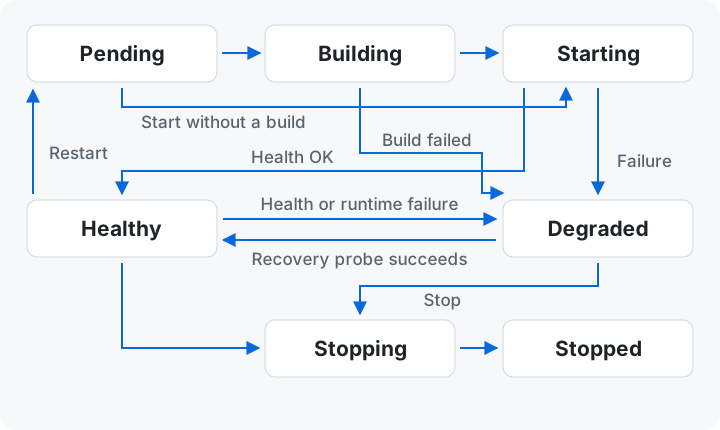
State constants live in internal/engine/state.go as ServiceState (iota enum: StatePending, StateBuilding, StateStarting, StateHealthy, StateDegraded, StateStopping, StateStopped, StateRestarting). Use the constants — raw strings only appear in JSON output. (StateRestarting remains defined for wire/String compatibility, but the current lifecycle routes a restart straight back to Pending rather than dwelling in it — see the state diagram above.)
Event loop
The orchestrator runs a single goroutine that consumes events from a buffered channel. Events are defined in internal/engine/state.go:
| Event | Emitted when | Typical reaction |
|---|---|---|
DepsReady | All declared depends_on targets reached Healthy | Start this service |
HealthOK | Probe succeeded after previous non-OK state | Mark Healthy; notify dependents |
HealthFail | Probe failed or timed out | Mark Degraded; may trigger restart |
ProcessExited | Child dev process exited | Mark Degraded (unexpected) or Stopped (expected) |
ContainerDrift | Docker poll says container state differs from Orbit's view | Reconcile: mark Degraded or re-sync |
BuildStarted / BuildComplete / BuildFailed | Service build step (e.g. dotnet build) lifecycle | Move through Building → Starting |
Shutdown | orbit down or signal | Cascade Stopping to all services in reverse DAG order |
(EventServiceLog carries a captured stdout/stderr line. It is dispatched through the same loop but triggers no state transition — it is broadcast to log subscribers (SSE, orbit logs), which is why it is absent from the transition table above.)
Events never mutate state directly — they are dispatched to the orchestrator which applies transitions synchronously. This keeps the state machine single-threaded and makes reasoning about races tractable.
Startup sequence

POST /api/up returns as soon as startup is dispatched (handlers_service.go calls StartServices then responds), not after everything is healthy — the CLI/dashboard watch convergence over the SSE status stream. Services are launched as soon as their declared dependencies reach Healthy. The DAG itself doesn't block — independent services start in parallel, except that non-watch .NET service builds share one context-aware admission gate. Their runtime processes still start independently as soon as each serialized build completes.
The response identifies the exact daemon-resolved resource set, including transitive dependencies and group filtering. The CLI waits only for that set. When the set is empty, up is an explicit successful no-op and returns immediately instead of entering a health timeout.
Container supervision vs process supervision
| Container | Process | |
|---|---|---|
| Owner | internal/container/manager.go | internal/process/manager.go |
| Start | Docker container.create + container.start | exec.Command under a fresh process group (setpgid on Unix, Job Objects on Windows) |
| Stop | Docker stop + 10s grace → kill | SIGTERM to the group → shutdown_timeout grace (default 30s) → SIGKILL to the group |
| Health | Polled every 2s via container.inspect plus the service's declared health_check | The declared health_check only |
| Drift detection | Successful Docker snapshots reconcile stopped, removed, or externally restarted containers | Implicit: if the process dies, ProcessExited fires |
Both kinds share the same state machine and event loop. The differences are entirely inside manager.go of each package.
Two consecutive Docker API failures invalidate previously healthy container claims without turning a brief transport hiccup into user-visible churn. status identifies Docker as the root cause and leads to orbit doctor. Orbit keeps polling and restores resource truth automatically when Docker returns; restarting Orbit or each container is not part of the recovery model.
Cross-platform process groups
Killing a dev process (e.g. dotnet watch) with SIGTERM often leaves grandchild processes running. Orbit solves this by putting every spawned process in its own process group and signalling the group, not the leader.
- Unix (
internal/platform/process_unix.goon Linux/macOS):syscall.SysProcAttr{Setpgid: true}, thensyscall.Kill(-pgid, sig)on shutdown. - Windows: Job Objects. The spawned process is attached to a job, and closing the job handle terminates every descendant atomically.
Result: orbit down reliably reaps the whole process tree — shell, dotnet watch reloading, or pnpm dev Vite instance — rather than signalling only the leader and leaving grandchildren behind.
Lifecycle cancellation and an explicit stop share one process-group termination. A restart waits until that exact process generation has exited and its manager record is removed before a replacement can be tracked. Late exit or health events from the replaced generation are ignored.
Process PID/PGID ownership is persisted immediately after registration, before health can be reported. After an abrupt daemon exit, Orbit safely retires a live persisted process before normal startup creates a fresh child; adopting it would retain output pipes connected to the dead daemon and could report a false recovery. A dead persisted PID becomes an ordinary stopped service. Containers carry namespace, service, and config-fingerprint labels, so a new daemon can adopt an exact running match or safely replace a stale owned container. External port-conflict reporting is reserved for resources Orbit cannot prove it owns.
Health check types
internal/health/checker.go implements five probe types:
| Type | Use case | Cadence |
|---|---|---|
http | HTTP endpoint returns 2xx; cleartext probes discover h2c or HTTP/1.1 per service generation and origin | Polled every health_check_interval, ramping up to it at startup (configuration) |
tcp | TCP port accepts connection | Polled, ramping up at startup like http |
exec | Run a command inside the container; exit 0 = healthy | Polled |
log | Regex match against container logs | Triggered by log tail |
healthcheck | Defer to Docker's own HEALTHCHECK result | Polled via inspect |
Probes run in a per-service goroutine with a context cancelled at stop — see internal/health/checker.go and the tests under internal/health/ (e.g. checker_test.go, recover_test.go) for the contract.
Cleartext HTTP protocol discovery tries h2c before HTTP/1.1 and caches the first protocol that returns a valid response. A valid non-2xx is an unhealthy verdict, not a fallback signal. Redirect targets are discovered per origin; the generation-scoped probe session drops all choices when the service stops.
After startup, every repeatable probe (http, tcp, exec, and Docker healthcheck) keeps running. A configurable consecutive-failure threshold prevents one transient miss from flapping the graph; one successful probe recovers a degraded resource. log remains a one-shot readiness signal because a past log match has no meaningful inverse probe.
Status assembly overlays dependency availability without rewriting lifecycle state. If a healthy process depends on a stopped or degraded resource, API views report it as degraded with blocked_by; direct dependencies form an inspectable chain. Restoring the root dependency makes the overlay disappear, so still-running dependents recover without a restart.
Daemon server
internal/daemonsrv/server.go is the single long-running process. It exposes:
- Unix socket (
~/.orbit/orbit.sock) — CLI ↔ daemon HTTP (REST/api/...) over the unix socket - Loopback TCP :19800 — same HTTP API plus the Svelte 5 dashboard (embedded via
go:embed) and SSE streams. Loopback Host validation and same-origin mutation checks protect the browser-facing control surface.
The unnamed runtime uses these legacy paths and names unchanged. Named runtime ownership, state layout, port persistence, and cleanup semantics are defined in Isolated runtime instances.
All HTTP handlers live in internal/daemonsrv/*.go by concern:
| File | Concern |
|---|---|
server.go | Router, middleware |
handlers_service.go | up/down/stop/restart/logs |
handlers_service_env.go | Per-service env var overrides |
handlers_mode.go | Per-service dev ↔ container mode switching |
handlers_logging.go | SSE log tail |
handlers_env_toggles.go | Per-env feature toggles |
handlers_events.go | SSE status event stream |
handlers_traces.go | Trace list / detail and OTLP log records (tracing.md) |
handlers_graph.go | Dependency DAG queries |
handlers_history.go | Past run history |
handlers_settings.go | User settings (workspace root) |
resource_snapshot.go | GET /api/resources — uniform, read-only resource snapshots |
envs.go / envs_dir.go | Env list / current |
doctor.go | Health diagnostics |
The daemon owns all shared state. CLI commands are stateless — they open the socket, make one request, print, exit.
Resource snapshot contract
GET /api/resources exposes containers, services, externals, databases, tunnels, and claimed routes in one display-oriented shape: {schema_version, env, resources}. Each resource has name, open-vocabulary type and state, optional parent and depends_on, and flat string properties.
The contract is additive: schema_version changes only for removals or renames. Consumers must render unknown resource types, states, fields, and properties generically. parent represents ownership; depends_on represents the startup graph. Ordering is deterministic with parents before children.
The snapshot does not replace purpose-built APIs. Streams, graph presentation, actions, and cross-machine tunnel claims remain in their domain endpoints.
Extension points
Common changes and where they land. Optional features wire commands, daemon routes, and dashboard panels through the internal/extension package; the points below cover changes to the core itself.
Add a new service type
- Extend the
Service.Typediscriminator ininternal/config/schema.go. - Add a launcher in
internal/engine/scheduler.gothat knows how to start that type. - If health-checking differs, add a probe type in
internal/health/checker.go. - Update
envs/example.yamlwith a reference entry.
Add a new health check type
- Add a case in
internal/health/checker.go(checker.probe()). - Document the YAML shape in
docs/configuration.md.
Add a new init hook
Current types: kafka_topics, mongo_rs. To add one:
- Add a case in
internal/container/init.go. - Define the config struct in
internal/config/schema.gounder the container'sinitblock.
Add a new CLI subcommand
- New file under
internal/app/returning a*cobra.Commandfrom afooCmd()factory. - Register it in
Main()ininternal/app/root.go. - If it talks to the daemon, add a handler in
internal/daemonsrv/*.goand call it from the command: adaemon.Clientmethod if the payload is wire-typed (theinternal/daemonpackage), or an unexported helper next to the command built onClient.GetDecode/PostJSONif the payload names core-internal types (seeinternal/app/traces.go,internal/app/history.go).
Ship a new asset alongside the binary
Embed via //go:embed rather than relying on an on-disk path — the installed binary has no source tree. See cmd/orbit/dashboard.go for the dashboard bundle (embedded in the binary's main package and injected into the daemon server; a branded binary embeds its own dashboard build the same way).
See also
- docs/configuration.md — full YAML schema reference
- docs/tracing.md — local OpenTelemetry workflow